See ya later Alligator

Since this is the last blog, I think it should be a memorable one; I do not want to end this on a bad or sad end. Instead of viewing this as a goodbye, I am going to view it as a see you later alligator style, because saying goodbye means you will not being seeing that person again for a long time, and I do not want to say that. Change really sucks sometimes, from freshmen year to now; everything is so different. Some good and some bad, depending on how you look at it.

For instance the first day of school. It was a big one because you had to meet new teachers, hope you find someone that you know in each of your classes, and get ready to learn a lot about whatever class you are in. I vaguely remember my first day in English class. We were all trying to get seats next to our friends; we had to create a name tag that represent us, and find a quote that inspires us. That day was a handful and to be honest I felt a little lost about how I was going to survive that class. But as time went on, I felt like the class got easier, not content-wise but like socially it was easier, because of all the activities we did.

The more activities we did, the closer we got as a class. The jeopardy questions- Mrs. Fischer and I talking about Ken winning Jeopardy Greatest, our socractive seminars and harkness discussions, and our book clubs brought us closer. The name game, which seems to be so challenge and amazing, was just normal because we became such a close class. Time really does fly by when you having fun. I really going to miss this class it has been some much fun. But time has change and so must we. This is not a good bye it is just a

– See You Later Alligator, until the next time!!!!

Image result for cya later alligator gifs

Free Time to Sleep? Nah

So after thinking about a topic for the past hour, I have no clue about what to write. So I went on my phone to look up topics to discuss, then I got sidetrack, and again. By the end of it, I somehow started watching a video on YouTube about some random topic, falling asleep during clips of the video. My point is that there has been a trend lately about sleep based on my personal experience and my peers. There seems to be a norm regarding the number of hours we sleep. Most people at school are getting around 5 hours of sleep a day, which is outrageous for the amount of work we get from school.

Lack of sleep is a big issue. There is evidence that proves lack of sleep will prevent your brain from creating new memories. Another risk is the increase in a toxic protein called beta-amyloid, which is associated with Alzheimer’s Disease, a progressive disease that destroys memory and other mental functions. Sleep deprivation affects more than just the brain; there are studies that show it can corrupt other systems in the body, such as the reproductive and immune system. After one night of four to five hours of sleep, there is a 70% reduction in anticancer cells. These effects are just a scratch of the surface.

Adolescents are supposed to get eight to ten hours of sleep a day, yet most of us get only five hours. There should be a fix for this problem. Sleep deprivation is not a joke. There was even a law created in New York for resident physicians to regulate the amount of work called the Libby Zion Law, named after Libby Zion, who died due to physicians, who were overworked, missing a diagnosis that led to her death. I think we should be more aware of our sleep schedule and make more of an effort to change it for our future.

Wormwood the D.I.T (devil in training)

Image result for wormwood screwtape letters

After getting settled with the introductions to the novel, I decided to take a closer look into one of the characters in The Screwtape Letter, by C.S. Lewis, named Wormwood. Wormwood is a recent graduate of the devil’s training college who is assigned to his first human whom he must tempt into Hell. As a full-fledged demon, Wormwood has the responsibility to convert his assigned human, however, he must rely heavily on his “uncle” Screwtape for help. Screwtape claims that demons live in the external world where time does not affect them, however, Wormwood seems to be a younger, and less experienced demon.

I was a little confused on how did C.S Lewis come with these ridiculous names, so I did some digging to see if Wormwood has any meaning. There is woody shrub named Wormwood that has a bitter aromatic taste but there’s a second meaning as well. Wormwood is a state or source of bitterness or grief. Perhaps this could be foreshadow to Wormwood’s character or just the overall personality of Wormwood? Since this book is biblical, I searched “Wormwood definition biblical” and Wikipedia says that wormwood was a star that fall from the sky and fell into water bodies, making them bitter and killing many. I kind of got some goosebumps from that. I think this could be some useful information to think as I continue to read this book.

Image result for wormwood definition biblical

As his patient lives in the human world, Wormwood would get distracted with all the destruction and mayhem Europeans have created from the war. In one of Screwtape’s letters to Wormwood, he writes, “ the amateurish suggestion in your last letter warns me… that is not the sort of thing that a nephew should write to his uncle… it reveals an unpleasant desire to shift responsibility” (Lewis 15). Screwtape’s choice of words helps paint a picture of Wormwood’s character and makes him more relatable to the reader. All the major characters in the novel, except the patient, are demons or entities that are hard to vision. However, I like how Lewis creates a bridge for the readers to understand each character. Wormwood is the classical adolescent of today’s world. Wormwood’s desire to shift responsibility reminds me a lot of adolescents because we also do not like taking on the full responsibilities of things. Wormwood getting distracted easily is equivalent to today’s world and procrastination. 

Based on Wormwood being less experienced and inattentive to his job, there is some reason to conclude that he possible could jeopardy his assignment or perhaps he could change as a character and become more attentive to his job and become more like his affectionate uncle.

First Thoughts about The Screwtape Letters

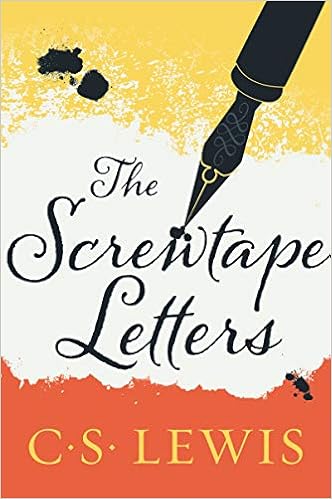
The Screwtape Letters, by C.S. Lewis, is through the point of view of a devil named Screwtape, who writes letters to his nephew- Wormwood- about his mission of converting humans into Satanist.

After reading just the first couple chapters, my initial thought was that this book would tell a story about how the “patient”, Wormwood’s assigned target, will progress through the eyes of Screwtape, however, each letter starts to become more of a lesson about humanity and how different moral values can affect our life. There’s a lot of irony found in this book such as Screwtape calling God, “The Enemy”, while the readers wouldn’t think of God in that sense.

The preface tells the readers about the overall idea of the story from C.S. Lewis’s point of view. There was one thing he advised the reader about devils and Screwtape, saying that the devil is a liar and that not everything Screwtape says is true. Now thinking about this, it kind of reminds me a little bit of The Book Thief, by Markus Zusak because both books have this entity as the narrator of the story. I remember talking about how Death as a narrator was not reliable due to his personal attachment to Liesel. Because of the reliability of the narrator in The Screwtape Letters and the time period of the story, I have some ideas about this novel following a modernism style.

This book also reminds me of this new television show named Evil on CBS. Evil is about a skeptical female psychologist named Kristen Bouchard, who joins David Acosta, a Catholic priest in training, to investigate the church’s backlog of unexplained mysteries that include, demonic possession, miracles, and other crazy phenomenons. Michael Emerson, who plays Dr. Leland and supposedly the devil himself, gives his patients advice that makes them do immoral actions. I am seeing come connection between this show and the book, which excites me as Evil is really good, so I have this book follows in the same way.

Brutus’s Role

After finishing the play Julius Caesar and looking back at some acts in detail, there seems to be a controversial topic about Brutus and the death of Caesar. Throughout the play, there have been many scenes in which Brutus has been manipulated, whether it be Cassius or Mark Antony, to doing something. However, we also know that Brutus was torn about some decision in his head during his confrontation with Cassius. Was it Brutus’s gullibility that leads to his demise, or was there some intent to killing Caesar?

There are multiple occasion in which Brutus was tricked into thinking under someone else; however only a few instants where Brutus expresses him. During the race, Brutus and Cassius had a discussion which was about Brutus, however developed into a plot to take the throne from Caesar. Brutus, however, stated ” Nor construe any further my neglect. Than that poor Brutus, with himself at war, forgets the shows of love to other men” (I.ii. 45). There isn’t a lot to conclude about what exactly Brutus is conflicted about, so based on inferences, the audience can only assume it is about Caesar in some fashion. The production of Julius Caesar by the African American Shakespeare Company gives some helpful interpretation to Brutus’s inner struggle from his body language and facial cues. His absented face after Cassius mentions stories about Caesar, and how Cinna talks truthfully about Caesar, help with the idea that Brutus was thinking about Caesar’s infinite power and popularity.

In contrast, we see both Mark Antony and Cassius take advantage of Brutus’s kindness to help incite their ideas about the future of Rome. We could view Act 1 Scene 2 as the first time Brutus was tricked into becoming a conspirator. Mark Antony’s last words to Brutus’s body, stating ¨he was the noblest Roman of all… a rare example of a real man¨ (V.v.) perhaps as an apology to Brutus, using his kindness and gullibility to avenge Caesar.

The Battle of Words: Antony V Brutus

Brutus, a very dear friend to Caesar and a well-known senator to Rome, commence a new era for Rome by assassinating the Tyrant Caesar. Mark Antony, a faithful friend and the right hand of Caesar, believes Caesar should have been king and wants justice for Caesar’s unlawful death. Ironical enough, these two drastically different characters share some similarities from their funeral speeches which are intriguing as they also differ.

In both speeches, the introduction is welcoming and has a joyful tone. They use similar words at the beginning such as” Romans” and “Countrymen” to help grab the attention of the audience. The rhetorical device used after being ethos. In Brutus’s case, he says, “Believe me for mine honor, and have respect to mine honor, that you may believe”, to make the people find Brutus trustworthy and accept his words. While Antony uses” the noble Brutus hath told you Caesar was ambitious” as a way for people to agree with him and to expand Brutus’s credibility. However, it was after the introduction where the two begin to contrast

Brutus relies heavily on his reliability and logical reason for his actions. His main argument is based on a hypothetical situation where Caesar can use his power to control all of Rome and support this will logical reason and the fact that he is Roman-like everyone else. Mark Antony, on the other-hand, emphasizes a lot of emotions such as grief, rage, and revenge; to help boost his emotions, he uses ethos only to acknowledge Brutus and his honor that was stated before. Brutus and Antony both used rhetoric as a tool in persuading the audience, opening both of their speeches with reassurance and a description of their identities; however diverge into contrasting topics.

Natural Reflection

During class on Monday, we analyzed and discussed a quote from Act 1, Scene 2 of Julius Caesar regarding eyes, and how they view objects. After being confronted by Cassius, Brutus is asked if he could see his face, his response was, “the eye sees not itself but by reflection, by some other things” (I.ii.52).

One way of viewing this quote is anatomical. The eyes convert light from the environment into electrical impulses which travel to the optic nerves, creating shapes and color that our brain perceives as reality. Since our eyes are positioned at the orbital, or eye-socket, region, it is physical impossible to view our body without any aid- even if your eye falls out of the socket, you wouldn’t see your body. One way humans see themselves is through reflection.

A more figurative and symbolic way of viewing Brutus’s words how reflection is interpreted. At the beginning of Cassius’s rhetorical speech, he repeats a pattern of powerful adjectives to boost Brutus and lower his guard. Brutus’s response about eyes evokes Cassius and makes him extend Brutus thought by saying, “so well as by reflection, I, your glass, will modestly discover to yourself” (I.ii.68). This extension helps readers to conclude that the people we interact with show us our reflection. A person’s actions, personality, and behavior are all the information needed for another person to reflection.

Another interesting idea that was discussed in class from Brandon was how reflection is not always accurate. This take on the quote relies heavily on our personal beliefs and who we want to be. Due to this false appearance, people are never truly satisfied with themselves, resulting in the endless chases for our dream reflection.

The Key to Desire

The key to obtaining a desire is from the work of rhetoric. Rhetoric, or the act of persuasion, is used in everyday language to help people convince or sway someone to a particular view or do a certain thing. In Julius Caesar, by William Shakespeare, one of the main characters named Cassius uses rhetoric to it is full extend in turning Brutus against Caesar. The method used by Cassius is unique due to his use of ethos, pathos, and logos. What is so eyeing is how he present these techniques so smoothly and uses other elements to help make his words more effective.

Cassius’ s introduction was in a playful manner, as he asks Brutus about the game, making the conversation friendly and open-ended. But he slowly slides into a more chivalrous way as he plants the first seed of his argument by playing with Brutus’s desires and well being. Brutus feels praised and welcomed as Cassius places him on a pedestal by telling him there are some hidden potential and worthiness of being Caesar’s equal. This type of pathos is used continuously by referring to Brutus as “good,” “gentle,” and “dear,” breaking the walls between Cassius and Brutus.

Furthermore, Cassius establishes ethos in the form of addressing himself as equal and even lower than Brutus as he calls himself dangerous and someone not to be around. The tipping point to Cassius’s persuasion was presented with stories that exemplify Caesar being unfit for the ruler of Rome. This form of logos makes Brutus question himself and even consider the idea of betraying Caesar. From the use of rhetoric and techniques, such as ethos, pathos, and logos, Cassius was able to shift Brutus to a crossroad of betraying or siding with Caesar.

Design a site like this with WordPress.com
Get started